

IF Intermittent Fasting | Does it Actually Work?

Intermittent Fasting thailand

In a world where body weight takes center stage, the concern becomes ubiquitous in the lives of many. The constant exposure to the societal ideal of the perfect physique fuels the ebb and flow of trending diets. Amidst the myriad diet and exercise regimens, scientific backing fortifies several, even though aggressive marketing occasionally veils authenticity. Emerging as the focal point of contemporary attention, IF Intermittent Fasting strides into the spotlight. But does it genuinely measure up to the claims, or is it merely a transient fitness phenomenon? Delving into its effects through a lens of professional evaluation might unveil the truth.

Intermittent Fasting hours

What is intermittent fasting?   

Intermittent fasting is a diet regimen that involves alternating cycles of fasting (with either no food or significant calorie reduction) and eating. Intermittent fasting is rooted in many traditional societies and religious group for its health or spiritual benefits. In such context, fasting typically entails a complete abstinence or reduced intake of food for a specific period of time.

Although we can draw a parallel example of intermittent fasting through the abstinence of food as we sleep, intermittent fasting as a diet regimen is known through several formal methods. These are further popularized in the mainstream media through specific diet method such as 16/8 and 5:2 diet.

In its systematic forms, intermittent fasting is practised as fasting on alternate days, for whole days with a specific frequency per week, or during a set time frame.

  •    Alternate-day fasting involves alternate days of no food restriction with days that consist of one meal that provides about 25% of daily calorie needs.

Example: Fasting on Monday, Wednesday and Friday while alternate days have no food restrictions.

  •    Whole-day fasting involves 1-2 days of complete fasting per week or up to 25% of daily calorie needs, while no food restriction is imposed on the other days.

Example: The 5:2 diet approach includes no food restriction five days of the week, combined with a 400-500 calorie diet the other two days of the week.

  • Time-restricted feeding involves a meal plan with a designated time frame for fasting in each day.

Example: 16/8 method in which fasting is imposed every day for 14-16 hours, with meal consumed during the remaining 8-10 hours of the day. If you finish your last meal at 8 pm, for example, and didn’t eat until 12 noon the next day, then you are technically fasting for 16 hours between meals.

Intermittent Fasting hours 8 16

Do I need to Limit Calories for Intermittent Fasting?

You may wonder then, on how intermittent fasting can be any different than other diet plans. Most diet plans involve a recommendation of limited calories intake. But our body is able to adapt to the prolonged calorie restriction through physiological changes and consequently prevent further weight loss. Intermittent fasting attempts to prevent these adaptations by cycling between a low-calorie level for a brief time followed by normal eating.

However, research does not consistently show that intermittent fasting is superior to continuous low-calorie diets for weight loss efficiency as theoretically suggested. It is discovered to be as efficient as diets that involve continuous calorie restriction to reduce body weights and fat mass but not necessarily a better method. So, consider which has the better long term health benefits.
But losing weight should not be the sole focus of the benefits of a diet plan. In term of physiological benefits, a large body of research has shown how fasting improves biomarkers of disease, reduce oxidative stress and preserve learning and memory functioning. According to Mark Mattson, senior investigator for the National Institute on Aging, part of the US National Institutes of Health, it is believed that as fasting imposed a mild stress on the cells, the cells responded adaptively by enhancing their ability to cope with the stress and perhaps, even resist disease.

Despite its promising benefits, the physiological changes reported are mostly through studies done on animals and not human. While a randomized controlled trial that followed 100 obese individuals on intermittent fasting for a year did not find significant differences in biomarkers such as blood pressure, heart rate and fasting glucose level compared to daily calorie restriction in a typical diet regimen.

Intermittent Fasting foods

Will I Binge Eat after long fasting periods?

Intermittent fasting is promoted to change body composition through loss of fat mass and weight and to improve markers of health that are associated with diseases such as blood pressure and cholesterol levels. Although its benefits are on par with other caloric restriction diet, it may not be as superior a choice as claimed by its proponents.

There is also a concern of binge eating on non-fasting days to compensate for calories lost during fasting. Understandably, prolonged periods of food deprivation may cause us to overeat when food is reintroduced, outweighing the benefits of intermittent fasting. But studies have not shown this to be true when compared with other weight loss methods.

This diet regimen may better suit people who typically eat one or two meals a day or do not eat for long stretches of time. While those who indulge in snacks between meals or eat every few hours may find it difficult to comply with it.

Intermittent Fasting health benefits

Ultimately, there is no diet plan that can be universally applicable to every person and eating a healthy balanced diet is recommended. There is always restriction that should be followed. Individuals with diabetes, eating disorders (anorexia or bulimia nervosa), on medication that require food intake, being pregnant, breastfeeding, in active growth state (adolescents) should abstain from intermittent fasting. 

Albeit promising look, there is still a vast area for further research in intermittent fasting. And the main thing to remember is that if your body feels happy and is being fuelled by the healthy foods, you’re probably on the right track. No one knows your body better than you! At Luma we are big advocates for the power of exercise combined with a healthy diet and appropriate calorie intake, and that is why all of our comprehensive health insurance plans give you privileged access to a range of gym memberships.

Hear it from our intermittent fasting Lumanians!

“For more than 3 years now, I’ve been practicing fasting. I began with the classic 16/8 cycle and have now settled comfortably into the 18/6 routine. Fasting has brought several positive changes for me: shedding fat, heightened focus during work, and the freedom to relish meals without fixating on calories. In the initial stages, it wasn’t a breeze, but within 1-2 weeks, your body adapts, making it a seamless part of your lifestyle. I’m not overly strict about intermittent fasting timings, considering the numerous variables at play. Some days, I extend the fast by an extra 1-2 hours, while other days, I break the fast earlier. On the whole, I’ve experienced benefits across all aspects of my lifestyle through fasting. To those considering giving it a try, I wholeheartedly recommend it. Just remember to grant your body the time to adjust, especially in the initial phases!”

-Zeke

“So, I decided to try out this 16/8 intermittent fasting thing overnight, and it actually worked wonders. My digestion got better, and I could even see the scales moving in the right direction. It was a breeze during the holidays when I could sleep in, but now that I’m back to work and the kids are up at the crack of dawn, it’s a whole different story. Getting up at 5 AM and not eating until 11 or 12 is tough, especially when I feel the pressure to make them a good breakfast. I’m tempted to give it another shot, though, even though I’m worried about the long mornings. The benefits were real, so I’m hoping to figure out a way to make it work, even with the early starts and hungry kids.”

-Natalie

LUMA's Health Insurance Plans

Best Travel Insurance to Thailand

Planning your trip and selecting the best travel insurance in Thailand can indeed be a daunting task, given the plethora of options available. Should you opt for the cheapest plan? Or perhaps the most expensive one?  

Allow us to simplify the process for you. With over 10 years of expertise in the insurance industry and having crafted the best travel insurance plans for Thailand. 

Why Do I Need the Best Travel Insurance Thailand?

Planning your dream trip to Thailand and wondering, “Why do I need travel insurance for my Thailand trip?” Well, Thailand is a land of adventure and excitement, but it can also be unpredictable. From exploring bustling cities to riding motorbikes through scenic landscapes and hopping on boats to Krabi islands, your journey is sure to be unforgettable. However, with such thrilling experiences, unexpected incidents can happen. 

That’s where the best travel insurance in Thailand for all inbound travel comes in handy! LUMA’s comprehensive services ensure you’re protected throughout your adventure. Whether it’s a sudden medical emergency due to a motorcycle accident, trip cancellation, lost baggage, or any other unexpected event on your trip to Thailand, our research in proposing the best travel insurance Thailand has got your back. 

Compare the Best Travel Insurance Thailand

FWDmsig travel insurance thailandluma logo travel insurancebest travel insurance thailand axatune travel insurance thailandworldtrip-Logo
Coverage★★★★★★★★★★★★★★★★
Price★★★★★★★★★★★★★★★★★★★★★
Customer Service★★★★★★★★★★★★★★★★★★
Hospital Network★★★★★★★★★★★★★★★★

Allow us to facilitate a head-to-head comparison of the best travel insurance Thailand through our star rating system. Our dedicated team has analyzed these insurance plans, considering essential aspects like coverage, pricing, customer service, and hospital network. We’ve assigned ratings from 1 to 5, with 5 being the highest, in each category to give you a comprehensive evaluation. Drawing from real-life experiences shared by our valued members and benchmarking travel insurance product in Thailand available online, we’ve curated valuable insights to assist you in selecting the best travel insurance for your Thailand adventure. 

Best Travel Insurance Thailand for Coverage: LUMA Travel Insurance

LUMA’s travel insurance plans for Thailand stand head and shoulders above the rest.

UNLIMITED Coverage for Evacuation and Repatriation

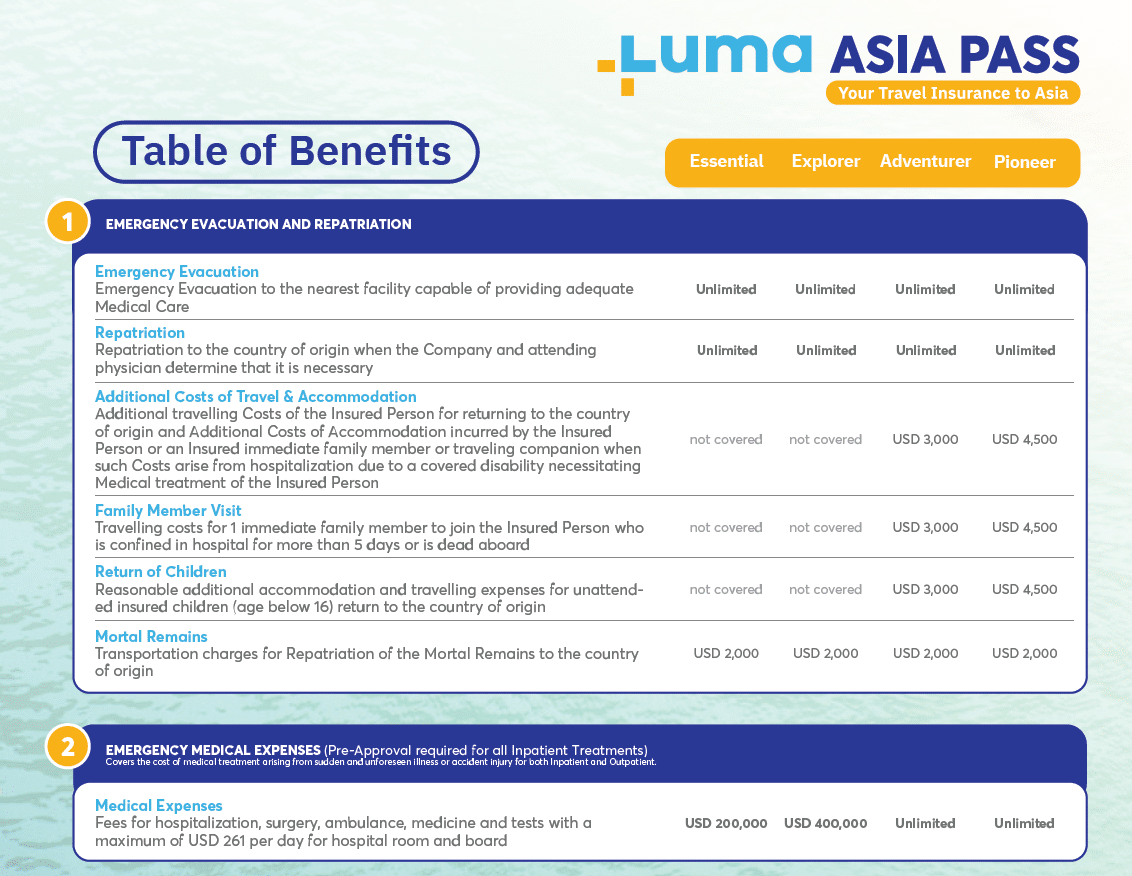
New Lineup of Plans: Essential, Explorer, Adventurer, and Pioneer plans! with extensive coverage ranging from 200,000 USD to UNLIMITED Medical Coverage.

best travel insurance asia pass

We believe in offering the ultimate value for your money, providing extensive services that’s tailor-made for all your Thailand trip needs. As any best travel insurance in Thailand should, ASIA PASS covers the basics, flights delays, baggage protection, trip cancellation, medical coverage, etc. 

What makes LUMA’s plan truly exceptional is its services that assist for accidents that may occur while riding or driving a motorcycle in Thailand. Our team carefully designed the ASIA PASS, keeping in mind the adventures travelers seek in Bangkok and captivating islands like Krabi, Koh Samui, Koh Samet, and Phi Phi. It’s no secret that renting motorcycles to explore these beautiful locations is a popular activity. In bustling Bangkok, where motorcycle taxi services abound, getting to popular tourist attractions is convenient. However, we understand that risks persist, and it’s crucial to consider the costs involved in recovering from a motorcycle accident. 

With LUMA travel insurance, we’ve got you covered for these unfortunate events that are more common in Thailand. Our aim is to ensure that you can fully enjoy your trip with peace of mind, knowing that you’re protected and supported throughout your journey.

motorbike accident thailand

Best Travel Insurance Thailand for Price: COVID Inbound Travel by FWD 

Budget-conscious traveler? No worries, COVID Inbound Travel by FWD has got you covered. If you’re looking for the cheapest travel insurance, then FWD is your go-to option. Their rates are super competitive, making it an affordable choice for your Thailand journey. 

However, it’s worth noting that their coverage is limited to COVID-19 in emergency stages only. So, while FWD is an excellent option for those seeking budget-friendly choices, make sure you’re aware of the coverage limitations and if they meet your needs. After all, we want you to have a worry-free trip, and that means knowing what you’re getting in your travel insurance. 

Best Travel Insurance Thailand for Best Customer Service: LUMA Travel Insurance

At LUMA, we believe that the best travel insurance Thailand can only be paired with a reliable customer service team. We genuinely care about your needs and concerns, as a company deeply rooted in Asia, our customer service team is well-versed in addressing all your questions and uncertainties and uncertainties you may have about your travel to Thailand. 

With us, you’ll experience speedy and reliable Thailand travel insurance questions whenever you need it. Whether it’s answering your pre-trip to Thailand inquiries or providing guidance through the claims process, we’ll be right there by your side, supporting you every step of the journey. We take your travel health seriously, and that’s why we have a team of in-house doctors who are here for a second medical opinion ensuring you have the best possible medical guidance and support. So, rest assured that with LUMA, you’ll receive the utmost care and attention throughout your adventure in Thailand. 

But don’t just take our word for it! Let’s hear from some of our happy travelers. 

Kishan Loitongbam
Kishan Loitongbam
Amazing customer support! The entire process was handled smoothly from beginning to end. The staffs are really informed and go the extra mile at every stage. Highly recommended.
Esle van Heerden
Esle van Heerden
The service was excellent! Emilie was a great help with so much patience. It truly makes a difference if you have someone that responds quickly and doesn’t complain about numerous emails being sent back and forth. Thanks for the excellent service Luma and especially Emilie!
Philip Seiter
Philip Seiter
Thank you Emilie and rest of the team for your great support and answering all my open questions. 🙂
Jeremiah Ell
Jeremiah Ell
I went to the Luma office in need of travel insurance for a trip in Southeast Asia. I met Clara who walked me thru the travel insurance details and different options available. She was familiar with all aspects of the policy and was able to answer my questions. Reccomended 😇

Best Travel Insurance Thailand for Best Hospital Network: Sawadee by AXA 

If a smooth and hassle-free claim process is your top priority for the best travel insurance in Thailand, Sawadee by AXA is the way to go. As one of the largest insurance companies in the market, AXA comes with extensive experience and a wide hospital network in Thailand. The best part? Hospital staff are usually well-acquainted with the brand and its benefits, making your travel insurance experience seamless and straightforward.  

AXA Sawadee stands out with its remarkable hospital network clinics across the country. This extensive network covers both public and private medical facilities. 

Sawadee by AXA is a popular choice when travelling to Thailand, however, keep in mind that the comprehensive services provided by AXA do come with a slightly higher price tag. If you’re willing to invest a little more for your Thailand trip then it is an excellent choice. 

Lumanian’s Tips on Travel Insurance Thailand

“I just wanted to give you a few tips travel Insurance to Thailand to all the readers here. First, make sure to read the Table of Benefits carefully to see what is and isn’t covered for Thailand. Some policies only cover medical expenses, while others also cover trip cancellation and lost luggage for your trip to Thailand. So, it’s best to understand your needs and match them with the correct benefits.  

Second, don’t just skim the policy. Read it carefully, especially the section on exclusions. This will help you understand what is and isn’t covered by the policy. For example, some policies may not cover activities like sports or trekking.”

-Dr. Kao (Product Manager at LUMA)

Travel Insurance to Thailand

LTR Visa Thailand (Long Term Resident Visa): Requirements and Guidelines

A Long Term Resident Visa (LTR Visa) is a type of visa that allows high potential foreigners to live and do business in Thailand with 10-year renewability. The LTR Visa is offered to four categories of individuals: wealthy global citizens, wealthy pensioners, work-from-Thailand professionals, highly-skilled professionals, and spouses and dependents.

LTR visa Thailand

What are the benefits of a LTR Visa?

  • 5 years validity, extendable to a total of 10 years stay in Thailand. 
  • Multiple entry visa
  • Fast track line at Thai international airports
  • No 90 days report, instead report annually to the Immigration
  • Permission to work in Thailand and facilitated work permit procedure at the BOI – LTR visa holders are not considered foreigners and exempt of the 4 Thai to 1 Foreigner ratio for employment 
  • Flat 17% personal income tax for highly-skilled professionals who hold a LTR Visa


What are the different Thai LTR Visa Categories?

  1. Wealthy Global Citizens
  2. Wealthy Pensioners
  3. Work-from-Thailand Professionals
  4. Highly-skilled Professionals


What are the requirements for an LTR Visa?

LTR Visa requirements for Wealthy Global Citizens

  • More than 1,000,000 USD in assets.
  • Minimum 80,000 USD/year in personal income in the past 2 years.
  • Investment of more than 500,000 USD in Thai government bonds, foreign direct investment, or Thai property.
  • Health Insurance in Thailand with more than 50,000 USD coverage or social security benefits insuring treatment in Thailand or at least 100,000 USD deposit.

LTR Visa requirements for Wealthy Pensioners

  • More than 80,000 – 100,000 USD/year in personal income at the time of application.
  • Must have at least 250,000 USD in Thai government bonds, foreign direct investment, or Thai property IF the personal income is below 80,000 USD/year but no less than 40,000 USD/year.
  • Health Insurance in Thailand with more than 50,000 USD coverage or social security benefits insuring treatment in Thailand or at least 100,000 USD deposit.

LTR Visa requirements for Work-from-Thailand professionals

  • More than 80,000 – 100,000 USD/year in personal income for no less then 12 months
  • Must have a Master’s degree or above or own intellectual property or receive Series A funding IF the personal income is below 80,000 USD/year but no less than 40,000 USD/year
  • Public company on a stock exchange or; Private company in operation for at least three years with combined revenue of at least 150,000,000 USD in the past 3 years
  • More than 5 years of work experience in the relevant fields on the current employment over the past 10 years
  • Health insurance with more than 50,000 USD coverage or social security benefits insuring treatment in Thailand or at least 100,000 USD deposit

LTR Visa requirements for Highly-skilled professionals

  • More than 80,000 – 100,000 USD/year in personal income in the past 2 years
  • Must have a Master’s degree or above in science and technology or special expertise relevant to the job assignment in Thailand IF the personal income is below 80,000 USD/year but no less than 40,000 USD/year
  • No minimum personal income for professionals working for Thai government agencies
  • Business in any targeted industries
  • Higher education institution, research education, specialized training institution, or Thai government agency
  • More than 5 years of work experience in the targeted industries except applicants with a Ph.D. or above in the relevant fields of the targeted industries or applicants working for Thai government agencies
  • Health insurance with more than 50,000 USD coverage or social security benefits insuring treatment in Thailand or at least 100,000 USD deposit.

LTR Visa requirements for Spouse and dependents

  • Health insurance with more than 50,000 USD coverage or social security benefits insuring treatment in Thailand or at least 25,000 USD deposit.

  • Must be the legal dependents. (Same-sex marriage or partnerships are not yet recognized by Thai law)


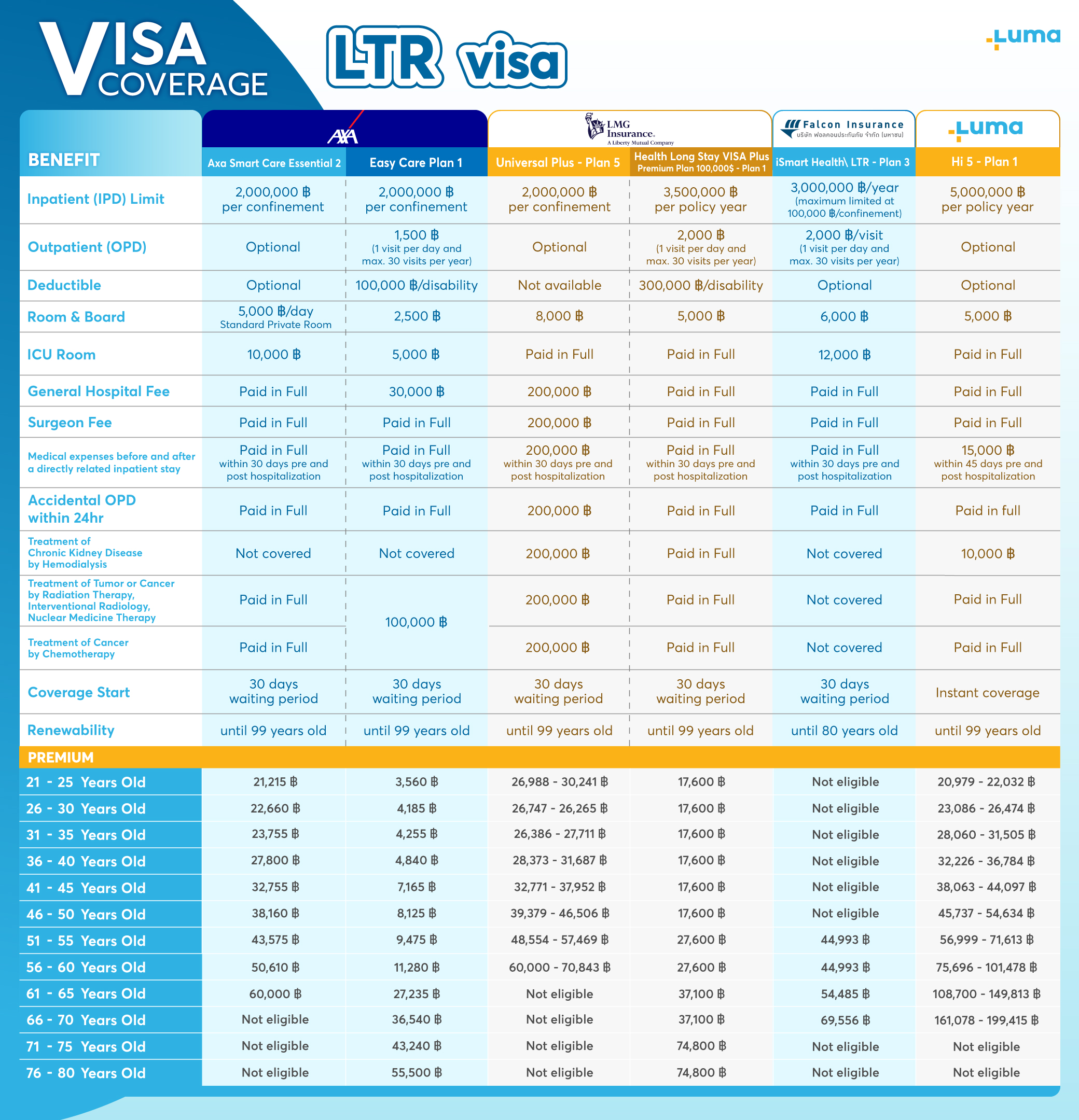
Health Insurance Requirements for LTR Visa

All applicants for the LTR Visa have a common requirement of having health insurance with at least 50,000 USD coverage.

LUMA provides a wide range of health insurance options not only for the LTR Visa but for your every need.

LTR Visa insurance Thailand

Contact LUMA to consult the right health insurance for you.

How to apply for LTR Visa

Register with the BOI and submit an online application for qualification endorsement and supporting documents. Applicants will receive the result within 20 working days.

Qualified applicants can apply for the LTR visa issuance at the Royal Thai Embassies/the Royal Thai Consulate Generals overseas or Immigration offices in Thailand within 60 days from the issuance date of the endorsement letter. 

How much does a LTR Visa cost?

The Visa processing fee for a 10-year visa with multiple entries is 50,000 THB per person when collecting the LTR Visa in Thailand. The fee may vary depending on the currency exchange rate of the country in case the applicant collects the LTR visa overseas.  

Enquire about health insurance for LTR visa

LUMA Care Application
Contact Us

Copyright © 2026 lumahealth.com. All Rights Reserved.   Privacy Policy & Terms of Conditions