

Healthcare costs in Thailand: 6 ways to stop overpaying at the hospital

Picture of Dr. Shun Pyae Min,
Dr. Shun Pyae Min,

Medically reviewed by Dr Shun Pyae Min, General Practioner, part of LUMA's Medical Team

Thailand has become one of Asia’s leading destinations for medical care. Its private hospitals draw patients from around the world, many hold international accreditation, and specialists are often foreign-trained and English-speaking. Facilities are modern, and same-day specialist appointments are normal. For expats used to waiting weeks for a consultation back home, the standard and speed of care are a genuine upgrade.


Because it is a premium private system, prices can vary widely. The same medicine, test, or scan can cost two to three times more from one facility to the next, and that is where costs quietly get out of hand.


If you are paying out of your own pocket, you will notice these differences right away. If you have insurance, you might not, because the bill goes straight to your insurer. Either way it matters: routine overcharges still eat into your annual limit, leaving less for the large, unpredictable events a plan is really there for, such as a serious illness, an accident, or surgery.


This guide is about getting the same care for a fair price. Whether you already have a plan or you are still comparing your options, the habits below help you avoid overpaying at a Thai hospital and keep more of your cover for when it counts.

The six ways at a glance

  1. Fill routine prescriptions outside the hospital.
  2. Question an overnight stay for observation.
  3. Ask where else your specialist operates.
  4. Confirm your cover before any planned care.
  5. Set up your policy to fit how you actually use care.
  6. Get a second medical opinion before major treatment.

1) The Retail vs. Private Hospital Pharmacy Gap

At LUMA, we compared our own medical insurance claims data with retail pharmacy prices in Bangkok. Private hospitals routinely charge two to six times the retail rate for common medicines, including antibiotics like Augmentin and allergy medicines like Zyrtec. The full breakdown is in the table below, from the LUMA Thailand Private Hospital Medication Markup Index.


For non-urgent refills, filling the same prescription at a retail pharmacy keeps everyday costs down and leaves more of your outpatient limit for when you really need it.

Table 1: LUMA Thailand Private Hospital Medication Markup Index (2024-2026)

Medication CategoryCommon Brand / Generic NameStrengthRetail pharmacy price per tablet (THB)Typical price at a private hospital in Bangkok (THB per tablet)Approximate Markup
Pain & FeverParacetamol (Tylenol)500 mg฿1.40 – ฿1.80฿4 – ฿15about 6x
Pain & FeverParacetamol (Sara / Bakamol)500 mg฿1.10 – ฿1.40฿2.50 – ฿5about 3x
Pain & FeverIbuprofen (Gofen / local)400 mg฿4 – ฿9฿18 – ฿25about 3x
Allergy & AntihistamineCetirizine (Zyrtec)10 mg฿12 – ฿15฿20 – ฿25about 2x
Allergy & AntihistamineCetirizine (Local generic)10 mg฿2 – ฿4฿7 – ฿10about 3x
Allergy & AntihistamineLoratadine (Claritin)10 mg฿10 – ฿12฿17 – ฿27about 2x
Allergy & AntihistamineChlorpheniramine (CPM)4 mg฿1 – ฿1.50฿5 – ฿8about 5x
AntibioticsAmoxicillin + Clavulanate (Augmentin)1 g / 625 mg฿25 – ฿45฿80 – ฿110about 3x
AntibioticsAzithromycin (Local generic)250/500 mg฿20 – ฿40฿55 – ฿70about 2x

Source: LUMA Thailand Private Hospital Medication Markup Index (2024–2026)

Methodology: Internal analysis of LUMA historical medical insurance claims in Thailand, cross‑referenced with publicly available retail pharmacy pricing (captured in real time).

Disclaimer: Markup figures are approximate and may vary by private hospital pricing tier.

Key Insights From This Data

  • Highest Markup: Standard Paracetamol (Tylenol) and Chlorpheniramine (CPM) carry the highest hospital premiums, costing up to 5x to 6x more per tablet than retail prices.
  • Antibiotics Inflation: Common antibiotics like Augmentin see a 3x markup, meaning a routine prescription can easily drain hundreds of extra Baht from an outpatient limit.
  • Smart Consumer Choice: Opting for local generic brands over imported names (e.g., generic Cetirizine instead of Zyrtec) at a retail pharmacy yields the deepest overall savings.

When the hospital pharmacy is still the right choice

  • Discharge medicines straight after a hospital stay
  • Controlled substances that retail pharmacies cannot stock
  • Medicines that need continuous refrigeration
  • Complex treatment where the doctor and pharmacist coordinate directly

What to say at the appointment

For a standard prescription, you can ask: “Can I have a written prescription to fill outside the hospital?” You can then buy the medicine at a retail chain such as Boots or Fascino, or at a local wholesale pharmacy.

2) Question an overnight stay for observation

After an outpatient visit or an emergency room trip, a doctor may suggest staying overnight for observation. When there’s an underlying condition, an accident, or a symptom like chest pain or a head injury, this is usually the right call.


Unfortunately, admissions aren’t always driven by medical need. Sometimes it is timing: if you arrive in the evening after the outpatient department has closed, overnight admission becomes the default. Sometimes it is well meant, such as admitting someone on an inpatient-only plan so their care is covered. Either way, you can end up admitted when you did not need to be.


Both patterns can leave you worse off. When an insurer later reviews the admission and decides it wasn’t medically necessary, the claim isn’t paid. You end up with a hospital bill for a room where no active treatment took place, for a case that could often have been managed at home in more comfort.


If the outpatient department has closed and you feel stable, you have options. You can ask whether your symptoms can be reviewed in the emergency room and treated as outpatient care, rather than admitted. You can ask what would change if you returned when the outpatient department reopens in the morning.


Any hospital stay also carries a risk from the care itself, including healthcare-associated infections. According to the World Health Organization, roughly 7% of hospitalised patients in high-income countries and 15% in low- and middle-income countries pick up an infection during their stay. A careful doctor weighs that risk against the benefit of being admitted.


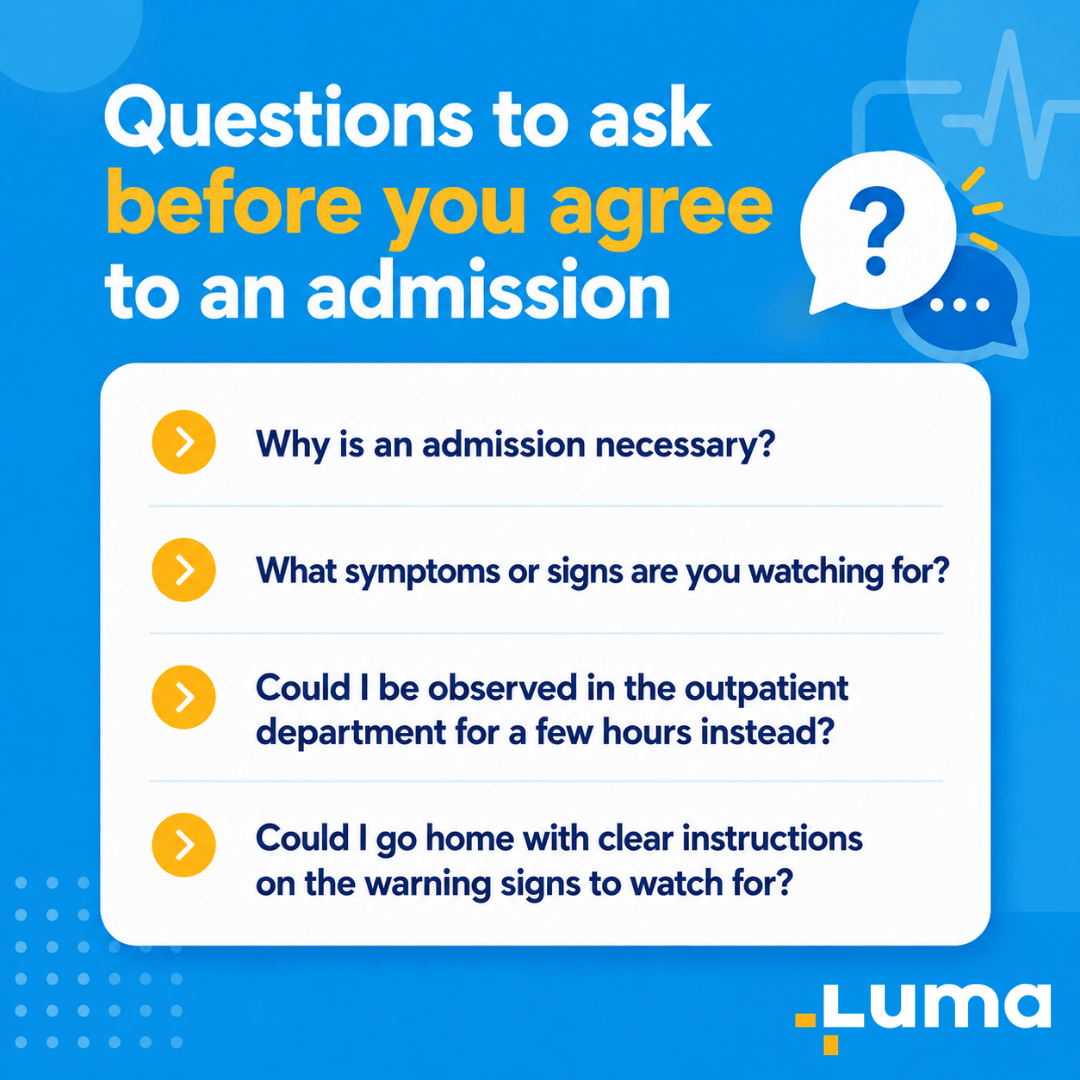
Questions to ask before you agree to an admission

expat healthcare costs in Thailand
  • Why is an admission necessary?
  • What symptoms or signs are you watching for?
  • Could I be observed in the outpatient department for a few hours instead?
  • Could I go home with clear instructions on the warning signs to watch for?


If it is not an emergency and you feel unsure, you can ask for an independent second medical opinion. If you decide to go home, some hospitals will ask you to sign a form recording that you declined the recommended treatment. This is a standard step to protect the hospital, and it is not a reason to worry on its own.

3) Ask where else your doctor operates

For a major procedure, the result depends more on the experience of your medical team than on the name of the hospital. The most expensive facility is not automatically the best choice for your case.


Prices for the same procedure can vary widely between private hospitals in Bangkok, often by two to three times. That difference rarely reflects better medical care. It often pays for comfort and services that do not change the result, such as a larger private room, concierge support, or an international wing.


Many specialists in Thailand work at more than one hospital, and many also operate at large academic hospitals as well as mid-tier private ones. For a planned procedure, ask your specialist which facilities they work in and request an estimate for each. You can often receive care from the same doctor at a hospital where the facility and operating room fees are much lower.


4) For planned care, get your cover confirmed in advance

Planned care means anything you know is coming: a scheduled procedure, a specialist consultation, an elective treatment. Unlike an accident or emergency, you have time to sort out the paperwork before you go in.


The step that matters is pre-authorisation. Before the treatment, share the proposed treatment plan and cost estimate with your insurer. They’ll review what’s covered under your plan, confirm the benefit limits, and issue a letter of guarantee to the hospital. Everyone starts on the same page: you know what your plan will pay, the hospital knows what to bill, and the insurer knows what to expect.


This is what prevents a surprise at the cashier desk. Anything outside the agreed plan and cost, such as an extra test added on the day or an upgrade to a different room category, needs to be checked and approved separately, otherwise it falls on you.


When the hospital is in your insurers’s network, this also unlocks direct billing, so the covered portion of the bill goes straight to the insurer. You avoid paying upfront and waiting for a refund.

5) Set up your policy so it fits how you live

The first four moves save you money at the point of care. This one works earlier, when you choose the plan. Three features give you room to adjust what you pay.


Deductibles. A deductible is a fixed amount you agree to pay on a hospital admission before the plan covers the rest. Accepting an inpatient deductible lowers your premium in exchange for covering that first amount yourself. If you already have group cover through an employer, a deductible works well on a private top-up plan: the group cover handles the first layer, and your private plan covers you beyond it at a lower premium.


Copayments. A copayment is a portion of a cost that you agree to cover, with the plan paying the rest. Plans can apply it in different ways: to a single benefit, to everything, or to the place where you receive care, such as a particular hospital. The purpose is to share the cost and the risk between you and the insurer, and in return your premium is usually lower. On LUMA’s Expat Essential, our health plan built around responsible, sustainble cover, the copayment applies at designated hospitals rather than at every hospital, so the choice of where to receive your care stays with you.


Outpatient cover. Outpatient cover pays for your everyday care: routine doctor visits, prescriptions, and minor treatments. For most people it is the part of the plan they use most, and where the day-to-day value sits. Inpatient cover is the core of the policy. If you genuinely use very little routine care and are comfortable paying cash for the occasional visit, you can leave outpatient cover off to lower your premium. For most members, keeping it is what makes the plan worthwhile week to week.

6) Ask questions, and get a second medical opinion when it matters

Every treatment you agree to becomes part of your care and part of your claim. Whether it’s a prescription, a scan, or a procedure, understanding what’s being proposed and why is what makes the decision genuinely yours.


In private healthcare, decisions can move quickly. A specialist recommends a course of treatment, and it’s easy to say yes without a full picture. Taking a moment to ask a few questions gives you clarity, gives your doctor a chance to explain the reasoning, and helps both of you land on the option that’s actually right for you.

Questions worth asking about a proposed treatment

  • Do I really need this? Could the condition improve on its own?
  • What is this treatment for, and what are you hoping it will achieve?
  • What are the risks and side effects for me, specifically?
  • Could this affect my future health in any way?
  • Are there simpler or safer alternatives worth trying first?


These questions work for a course of antibiotics, a suggested surgery, or anything in between.

For bigger decisions, a second medical opinion

For major treatment, especially surgery or a serious diagnosis such as cancer, a second medical opinion gives you confidence before you commit. It’s a safety step, not a sign of doubt.


For LUMA members, Medipro coordinates independent case reviews. Each review is carried out by a senior specialist who is at least as experienced as the first doctor you saw, never less. The specialist looks at the diagnosis, the proposed treatment, and any hospital cost estimate, so you can be sure the care in front of you is the right care. If the second medical opinion agrees with the first, you can go ahead knowing two specialists reached the same conclusion. If it differs, you have options to weigh. Those options can include care at more than one hospital, each with its own cost, so you can consider the medical choice and the price together.

Talk to a LUMA advisor

The right structure depends on how you live, how often you use care, and what you want protected. A LUMA advisor can help you set up your cover so it fits, and so it is there in full when you need it most.

Can I fill a prescription from a Thai hospital at an outside pharmacy?

In most cases, yes. You can ask your doctor for a written prescription and fill it at a retail pharmacy. Some medicines cannot be dispensed outside the hospital, such as controlled substances or medicines that need immediate hospital administration.

What is a deductible, and will it lower my premium?

A deductible is a fixed amount you pay on a hospital admission before your cover pays the rest. Choosing one lowers your premium, because you take on the small, predictable costs, while your full annual limit stays available for a large event.

Should I get a second medical opinion if my insurance covers the full cost of surgery?

Yes. A second medical opinion is a health safety step, not a financial one. It helps confirm whether a procedure is the right choice, which protects you from unnecessary risk and keeps your limit available for future needs.

Are You Checking Your Smartwatch Data Enough… or Too Much?

By Dr. Shun Pyae Min, General Practitioner

Part of our medical team at LUMA, Dr. Shun holds an M.B.,B.S. and has over 8 years of experience in hospital and general practice. Here he explains how to read your smartwatch health data wisely, and when a number is worth a doctor’s visit.

Smartwatches, fitness trackers, smart rings like Oura, and recovery trackerse like Whoop are part of everyday life now, and so is the health data on your wrist. A glance at the screen shows how active you have been, how well you slept, and whether your heart rate looks higher than usual.

For a lot of people that feels useful. It can also turn into a habit: checking the screen over and over, comparing today with yesterday, worrying about every number.

The question is not whether the data helps. It is whether you are reading it in a balanced way.

A wearable is good at showing trends over time, which can keep you moving in a healthier direction. It does not replace a doctor’s judgement or proper testing. It can point you the right way. It cannot do the examining for you.

The upside of checking your smartwatch health data regularly

Paying attention to the data does help. It raises your awareness. It nudges you to move, to stand up, to sleep a little better. A steady step count or an extra few minutes of walking is a small win, and small wins add up.

It can also surface patterns you would otherwise miss. A resting heart rate that creeps up over a few weeks, tiredness that will not shift, or a run of bad nights is worth noticing. Often that is the thing that finally gets someone to book a checkup they had been putting off.

Wearables are especially useful if you live with a chronic condition. A daily reminder to take medication or to move a bit keeps you involved in your own care, and that involvement matters.

The downside of checking too often

Checking too often has a cost too.

The clearest one is anxiety. When every small change becomes a reason to worry, the data stops helping and starts wearing you down. A high heart rate after a workout, a bad night after a stressful day, a quiet week when you were busy: none of that is an emergency. But constant checking can make small blips feel like big problems.

There is also the pull to overreact. Readings are not perfect. A loose strap, poor skin contact, dehydration, a drink the night before, or a cold can all throw the numbers off. A figure that looks alarming often means very little. In clinic I see this a lot: someone worried about a single high reading that turns out to be nothing. Treat every wobble like a diagnosis and a harmless number can leave you frightened for no reason.

Then there is plain fatigue. Check often enough and your health turns into a daily performance review. Miss the target and you feel you have failed, even in a week when you are doing fine.

smartwatch health data

The middle ground: useful attention, not constant obsession

So do not ignore the data, but do not treat it as the final word either.

Look often enough to stay informed, not so often that it runs your day. A weekly glance at your smartwatch health data tells you more than a check every couple of hours. One odd reading rarely means much. A pattern over several weeks usually does.

Think of the watch as a signpost. It can flag that your sleep has been slipping or that your activity has dropped off. What it cannot do is weigh that against your symptoms, your history, and a proper examination.

Whether the data comes from a smartwatch, an Oura ring, a Whoop band, or another wearable, the same rule applies: it is most useful when you look at trends, not single readings.

Why medical advice still matters most

The part I most want patients to hold onto is simple: a wearable is a helpful tool, not a stand-in for medical care.

If a symptom is worrying you, see a doctor. That might mean a checkup, some tests, a specialist referral, or a proper look at symptoms that are severe or will not go away. The watch can be the thing that prompts you to book the appointment. It should not be the thing that convinces you not to.

A doctor reads your symptoms in context, alongside your history, your risk factors, an examination, and your test results. Your watch data can feed into that conversation. It cannot be the conversation.

So the watch’s job here is usually to get you to act, not to make the call for you.

A practical way to use your device

A few habits keep the watch useful:

  • Follow the trend over days and weeks, and let the one-off spikes go.
  • Let how you feel count for as much as what the screen says.
  • Use the numbers to build better habits, not to beat yourself up.
  • Take anything that persists to a doctor.
  • Act on urgent symptoms straight away, whether or not the watch flags them.

Used this way, a wearable keeps you pointed at better health without eating up your attention every time a number moves.

Final thought

Smartwatches and other wearables can be extremely useful. They can make health more visible, motivate healthier routines, and help people stay engaged with their wellbeing. But they work best when they are kept in perspective.

The point is not to check constantly. It is to check well. Let the watch keep you on a healthier path, and leave the bigger picture to your doctor. Get that balance right and the technology helps you without taking over your peace of mind.

antibiotic misuse

This article was written by Dr. Shun, sharing his thoughts on health data from wearable devices and how the information should be interpreted.

Dr. Shun Pyae Min

Medical Team

Staying Active in a Tropical Climate: How to Exercise Safely in Heat, Humidity, and Monsoon Season

Picture of Medically reviewed by:Dr. Lwin Thiri Aye, MB.BS
Medically reviewed by:Dr. Lwin Thiri Aye, MB.BS

Dr. Lwin holds an MB.BS from the University of Medicine 1, Yangon, and has more than five years of clinical experience as a licensed doctor across local, international, and government hospitals.

Living in Southeast Asia means exercising in tropical climate conditions that are among the most demanding environmental challenges the human body can face. For much of the year, active expats and global professionals must navigate high heat, heavy humidity, monsoon downpours, and seasonal periods of poor air quality where PM2.5 levels spike significantly above safe baselines.


A workout that feels routine in a cooler setting can feel intensely taxing here—an experience thoroughly documented in exercise science. Fortunately, the human body adapts remarkably well to these conditions over time. By implementing a few evidence-based adjustments, you can learn to exercise safely in the heat, train comfortably, and protect your long-term health through every seasonal shift.

Understand Why Heat and Humidity Amplify Cardiovascular Strain

When you exercise, your muscles generate a large amount of internal heat. The body releases that heat primarily through evaporative cooling—the evaporation of sweat from your skin.


However, exercising in heat and humidity alters this mechanism. In a highly humid climate, the ambient air already holds a high saturation of moisture. This causes two distinct physiological shifts:


  • Reduced Evaporation: Sweat cannot evaporate efficiently off the skin, severely blunting your body’s primary cooling mechanism.
  • Cardiovascular Drift: To compensate, the body redirects blood flow away from the working muscles and toward the skin to radiate heat. Consequently, your heart rate rises to keep both systems supplied.
 

This explains why a workout at your familiar pace feels noticeably harder in the tropics, and why your heart rate may continue to climb during a session even if your effort remains constant. These are normal responses to heat stress, not a sign of diminished fitness

“Feeling slower when exercising in a tropical climate is an expected physiological response, not a fitness setback. Your body is working double-time to keep you cool. With steady, sensible training, your cardiovascular system adapts completely within 7 to 14 days.”

Read the Heat Index, Not Just the Temperature

The ambient temperature on your weather app does not accurately reflect how demanding an outdoor workout will feel. For exercise safety, you must monitor the Heat Index (the “feels like” temperature), which factors in relative humidity.

As the heat index rises, your core temperature and heart rate climb faster, causing you to tire sooner and increasing the risk of heat-related illnesses.

The Thailand Department of Health 4-Level Heat Index System

To plan outdoor activities safely, follow the official guidelines established by the Thailand Department of Health and the Thai Meteorological Department:

Heat Index (Feels Like)Risk LevelAction Required
27.0°C – 32.9°CCautionSafe for general exercise; stay hydrated.
33.0°C – 41.9°CWarningReduce outdoor activity during peak hours (11:00 AM – 3:00 PM).
42.0°C – 51.9°CDangerHigh risk of heat illness. Postpone intense outdoor workouts or move indoors.
≥ 52.0°CVery Severe DangerAvoid all outdoor activity. Train strictly in air-conditioned environments.

During the hot season (typically March to mid-May), relative humidity causes these readings to spike rapidly. For example, an air temperature of 36°C combined with typical tropical humidity can produce a feels-like figure above 50°C.

Give Your Body Time to Adapt (Heat Acclimatization)

According to joint guidance from the American College of Sports Medicine (ACSM) and the National Athletic Trainers’ Association (NATA), the human body requires 7 to 14 days of regular, moderate activity in warm conditions to achieve proper heat acclimatization for expats and newcomers.

During this 1-to-2-week period, your body undergoes several measurable physiological adaptations:

  • You begin sweating earlier and more efficiently.
  • Your sweat becomes more dilute, meaning you lose less essential salt.
  • Your blood plasma volume increases, allowing for better cardiovascular performance.
  • Your heart rate at a given effort level decreases, and your core body temperature becomes easier to regulate.

How to Track Your Acclimatization

  • With a Smartwatch: Monitor a repeating, standardized workout over two weeks. Look for a lower average heart rate and a faster heart rate recovery (HRR) post-exercise.
  • Without a Device: Assess subjective markers. Are you sweating sooner in your workout? Does the same pace feel easier? Are you recovering faster with less residual fatigue? If yes, your body is adapting.

Time Your Sessions Around Heat and Monsoon Rain

Strategic scheduling is the easiest way to mitigate environmental stress when exercising in tropical climate zones:

  • Peak Heat Windows: Avoid the midday sun entirely. Prioritize the cooler windows of early morning (before 7:30 AM) or evening after sunset.
  • Monsoon Management: During the rainy season, weather patterns show that storms frequently arrive in short afternoon bursts. Plan outdoor sessions for the morning to avoid both peak heat and sudden torrential downpours.

exercising in tropical climate

Plan Around Air Quality in the Burning Season

In northern Thailand and parts of the wider Mekong region, air quality drops heavily during the agricultural burning season, generally between February and April. This raises levels of PM2.5—fine particulate matter small enough to pass directly into the bloodstream via the lungs. Because exercise increases your ventilation rate (breathing depth and speed), it accelerates your pollutant intake.

Following United States Environmental Protection Agency (EPA) and WHO air quality frameworks, adjust your training based on the Air Quality Index (AQI):

  • AQI 101–150 (Unhealthy for Sensitive Groups): Individuals with asthma, allergies, or heart/lung conditions should move workouts indoors.
  • AQI 151–200 (Unhealthy): Everyone should avoid prolonged, intense outdoor exertion and shift to indoor alternatives.
  • AQI > 200 (Very Unhealthy): Strictly avoid all outdoor exercise.

“During the haze months, make checking a reliable local AQI app part of your pre-workout routine. When the readings cross safe thresholds, shifting your workout indoors protects your respiratory health without breaking your fitness momentum.”

Hydrate for Both Fluid and Salt Balance

When you sweat heavily while trying to exercise safely in the heat, you lose both water and essential electrolytes—primarily sodium.

  • Short Sessions (<60 mins): Plain water is completely sufficient.
  • Long/Intense Sessions (>60 mins): The ACSM recommends replacing sodium alongside fluids to prevent fatigue, muscle cramping, and hyponatremia (dangerously low blood sodium levels).

Electrolyte Replacement Formula

To match standard sports medicine guidance, aim for 500 to 700 milligrams of sodium per liter of water during extended sessions. You can achieve this via:

  • A DIY Mix: Approximately 1/4 teaspoon of standard table salt, sea salt, or rock salt per liter of water.
  • Commercial Options: Standard electrolyte tablets, sports drinks, or oral rehydration salts (ORS) from a pharmacy.

Note: If you have been medically advised to restrict salt intake due to hypertension or kidney disease, consult your physician before altering your sodium routine.

Know When to Stop: Recognize Heat Illness

Heat illness operates on a continuum, progressing from mild cramps to severe heat exhaustion or life-threatening heat stroke. Immediately halt your workout, move to an air-conditioned space, drink cool fluids, and actively cool your skin if you experience any of these warning signs:

  • Dizziness or lightheadedness
  • Headaches or nausea
  • Localized muscle cramping
  • An abnormally elevated heart rate out of proportion to your effort
  • Confusion, disorientation, or a sudden cessation of sweating despite intense heat

“Never try to 'push through' symptoms of overheating. Dizziness, headaches, or nausea are clear medical signals to stop, rest, and cool down immediately. The vast majority of heat-related emergencies are entirely preventable if you listen to these early signs.”

High-Risk Groups: Who Should Take Extra Care?

Certain individuals experience the cardiovascular strains of heat stress much sooner and should exercise with heightened caution:

  • Individuals managing chronic heart, circulatory, or respiratory conditions.
  • Those who are pregnant.
  • Anyone taking specific medications that alter thermoregulation, including beta-blockers (blood pressure), diuretics, and certain antihistamines which can suppress sweating or accelerate dehydration.

How LUMA Supports Your Health Across Southeast Asia

Maintaining a consistent exercise routine is a cornerstone of long-term wellness, but it works best when paired with proactive medical care. Comprehensive health checkups and rapid access to trusted medical professionals ensure minor physiological stressors are identified before they escalate into emergencies.

At LUMA, we design comprehensive health insurance solutions tailored to the unique lifestyle of expats and global professionals in Southeast Asia. From comprehensive wellness checkups to elite regional medical networks, LUMA ensures you have the support needed to live an active, healthy lifestyle with complete peace of mind.

Why do I feel more tired exercising in a tropical climate?

High relative humidity prevents sweat from evaporating efficiently. Because evaporation is your body’s main cooling mechanism, your heart has to pump harder to redirect blood to the skin for heat dissipation, leaving less oxygenated blood for your muscles. This is a normal climate response, not a drop in your actual fitness level.

How long does it take to get used to exercising in the heat?

For most individuals, complete heat acclimatization for expats and newcomers takes between 7 to 14 days of consistent, moderate exposure.

Should I exercise outdoors during the burning season?

If the local Air Quality Index (AQI) rises above 100 (for sensitive groups) or above 150 (for the general public), you should move your training indoors to a gym or climate-controlled space to avoid inhaling harmful PM2.5 particulates.

Do I need an electrolyte drink, or is water enough?

Plain water is perfectly adequate for workouts lasting under 60 minutes. For sessions extending past an hour, or if you sweat heavily, adding 500–700mg of sodium per liter helps protect against cramping and hyponatremia.

Sources

  1. World Health Organization (WHO). Global Air Quality Guidelines; Ambient (outdoor) air pollution fact sheet.
  2. American College of Sports Medicine (ACSM). Position Stand: Exercise and Fluid Replacement.
  3. Roberts WO, et al. / ACSM. Expert Consensus Statement on Exertional Heat Illness. Medicine and Science in Sports and Exercise.
  4. National Athletic Trainers’ Association (NATA). Inter-association Task Force Narrative Review on Exertional Heat Illness and Heat Acclimatization.
  5. United States Environmental Protection Agency (AirNow). Air Quality Index (AQI) Guidance for Outdoor Activity.
  6. Thailand Department of Health & Thai Meteorological Department. Official Heat Index Warning Framework.

Disclaimer: This article is for general informational purposes only and is not a substitute for personalized medical advice. If you have an underlying heart or lung condition, are pregnant, or take regular prescription medications, always consult your physician before starting or modifying an exercise regimen in high-heat environments.

LUMA Care Application
Contact Us

Copyright © 2026 lumahealth.com. All Rights Reserved.   Privacy Policy & Terms of Conditions