



Dr. Lwin holds an MB.BS from the University of Medicine 1, Yangon, and has more than five years of clinical experience as a licensed doctor across local, international, and government hospitals.
Living in Southeast Asia means exercising in tropical climate conditions that are among the most demanding environmental challenges the human body can face. For much of the year, active expats and global professionals must navigate high heat, heavy humidity, monsoon downpours, and seasonal periods of poor air quality where PM2.5 levels spike significantly above safe baselines.
A workout that feels routine in a cooler setting can feel intensely taxing here—an experience thoroughly documented in exercise science. Fortunately, the human body adapts remarkably well to these conditions over time. By implementing a few evidence-based adjustments, you can learn to exercise safely in the heat, train comfortably, and protect your long-term health through every seasonal shift.
Understand Why Heat and Humidity Amplify Cardiovascular Strain
When you exercise, your muscles generate a large amount of internal heat. The body releases that heat primarily through evaporative cooling—the evaporation of sweat from your skin.
However, exercising in heat and humidity alters this mechanism. In a highly humid climate, the ambient air already holds a high saturation of moisture. This causes two distinct physiological shifts:
- Reduced Evaporation: Sweat cannot evaporate efficiently off the skin, severely blunting your body’s primary cooling mechanism.
- Cardiovascular Drift: To compensate, the body redirects blood flow away from the working muscles and toward the skin to radiate heat. Consequently, your heart rate rises to keep both systems supplied.
This explains why a workout at your familiar pace feels noticeably harder in the tropics, and why your heart rate may continue to climb during a session even if your effort remains constant. These are normal responses to heat stress, not a sign of diminished fitness
“Feeling slower when exercising in a tropical climate is an expected physiological response, not a fitness setback. Your body is working double-time to keep you cool. With steady, sensible training, your cardiovascular system adapts completely within 7 to 14 days.”
Dr. Lwin Thiri Aye, MB.BS, Medical Team at LUMA Health
Read the Heat Index, Not Just the Temperature
The ambient temperature on your weather app does not accurately reflect how demanding an outdoor workout will feel. For exercise safety, you must monitor the Heat Index (the “feels like” temperature), which factors in relative humidity.
As the heat index rises, your core temperature and heart rate climb faster, causing you to tire sooner and increasing the risk of heat-related illnesses.
The Thailand Department of Health 4-Level Heat Index System
To plan outdoor activities safely, follow the official guidelines established by the Thailand Department of Health and the Thai Meteorological Department:
| Heat Index (Feels Like) | Risk Level | Action Required |
|---|---|---|
| 27.0°C – 32.9°C | Caution | Safe for general exercise; stay hydrated. |
| 33.0°C – 41.9°C | Warning | Reduce outdoor activity during peak hours (11:00 AM – 3:00 PM). |
| 42.0°C – 51.9°C | Danger | High risk of heat illness. Postpone intense outdoor workouts or move indoors. |
| ≥ 52.0°C | Very Severe Danger | Avoid all outdoor activity. Train strictly in air-conditioned environments. |
During the hot season (typically March to mid-May), relative humidity causes these readings to spike rapidly. For example, an air temperature of 36°C combined with typical tropical humidity can produce a feels-like figure above 50°C.
Give Your Body Time to Adapt (Heat Acclimatization)
According to joint guidance from the American College of Sports Medicine (ACSM) and the National Athletic Trainers’ Association (NATA), the human body requires 7 to 14 days of regular, moderate activity in warm conditions to achieve proper heat acclimatization for expats and newcomers.
During this 1-to-2-week period, your body undergoes several measurable physiological adaptations:
- You begin sweating earlier and more efficiently.
- Your sweat becomes more dilute, meaning you lose less essential salt.
- Your blood plasma volume increases, allowing for better cardiovascular performance.
- Your heart rate at a given effort level decreases, and your core body temperature becomes easier to regulate.
How to Track Your Acclimatization
- With a Smartwatch: Monitor a repeating, standardized workout over two weeks. Look for a lower average heart rate and a faster heart rate recovery (HRR) post-exercise.
- Without a Device: Assess subjective markers. Are you sweating sooner in your workout? Does the same pace feel easier? Are you recovering faster with less residual fatigue? If yes, your body is adapting.
Time Your Sessions Around Heat and Monsoon Rain
Strategic scheduling is the easiest way to mitigate environmental stress when exercising in tropical climate zones:
- Peak Heat Windows: Avoid the midday sun entirely. Prioritize the cooler windows of early morning (before 7:30 AM) or evening after sunset.
- Monsoon Management: During the rainy season, weather patterns show that storms frequently arrive in short afternoon bursts. Plan outdoor sessions for the morning to avoid both peak heat and sudden torrential downpours.
Plan Around Air Quality in the Burning Season
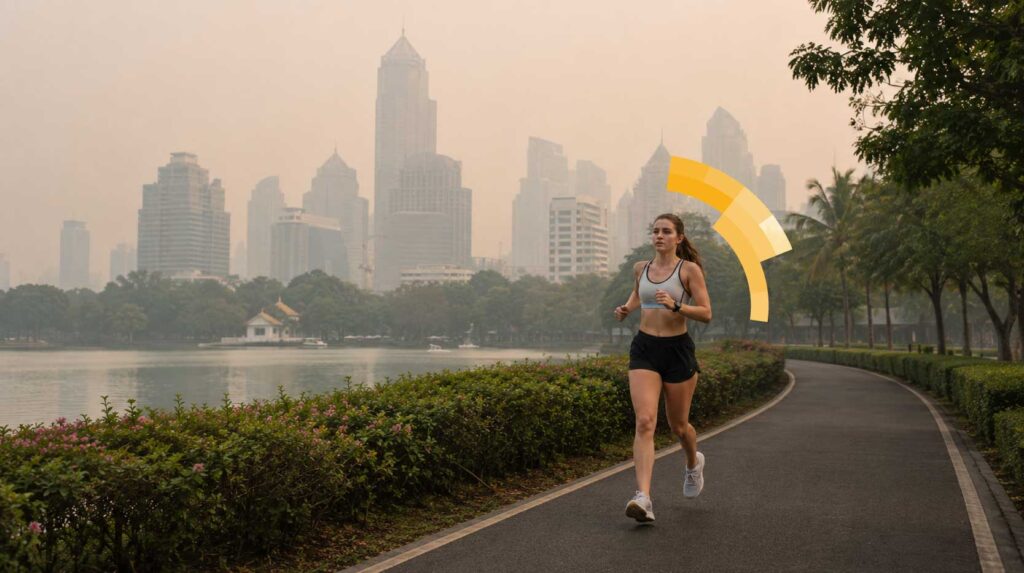
In northern Thailand and parts of the wider Mekong region, air quality drops heavily during the agricultural burning season, generally between February and April. This raises levels of PM2.5—fine particulate matter small enough to pass directly into the bloodstream via the lungs. Because exercise increases your ventilation rate (breathing depth and speed), it accelerates your pollutant intake.
Following United States Environmental Protection Agency (EPA) and WHO air quality frameworks, adjust your training based on the Air Quality Index (AQI):
- AQI 101–150 (Unhealthy for Sensitive Groups): Individuals with asthma, allergies, or heart/lung conditions should move workouts indoors.
- AQI 151–200 (Unhealthy): Everyone should avoid prolonged, intense outdoor exertion and shift to indoor alternatives.
- AQI > 200 (Very Unhealthy): Strictly avoid all outdoor exercise.
“During the haze months, make checking a reliable local AQI app part of your pre-workout routine. When the readings cross safe thresholds, shifting your workout indoors protects your respiratory health without breaking your fitness momentum.”
Dr. Lwin Thiri Aye, MB.BS, Medical Reviewer at LUMA Health
Hydrate for Both Fluid and Salt Balance
When you sweat heavily while trying to exercise safely in the heat, you lose both water and essential electrolytes—primarily sodium.
- Short Sessions (<60 mins): Plain water is completely sufficient.
- Long/Intense Sessions (>60 mins): The ACSM recommends replacing sodium alongside fluids to prevent fatigue, muscle cramping, and hyponatremia (dangerously low blood sodium levels).
Electrolyte Replacement Formula
To match standard sports medicine guidance, aim for 500 to 700 milligrams of sodium per liter of water during extended sessions. You can achieve this via:
- A DIY Mix: Approximately 1/4 teaspoon of standard table salt, sea salt, or rock salt per liter of water.
- Commercial Options: Standard electrolyte tablets, sports drinks, or oral rehydration salts (ORS) from a pharmacy.
Note: If you have been medically advised to restrict salt intake due to hypertension or kidney disease, consult your physician before altering your sodium routine.
Know When to Stop: Recognize Heat Illness
Heat illness operates on a continuum, progressing from mild cramps to severe heat exhaustion or life-threatening heat stroke. Immediately halt your workout, move to an air-conditioned space, drink cool fluids, and actively cool your skin if you experience any of these warning signs:
- Dizziness or lightheadedness
- Headaches or nausea
- Localized muscle cramping
- An abnormally elevated heart rate out of proportion to your effort
- Confusion, disorientation, or a sudden cessation of sweating despite intense heat
“Never try to 'push through' symptoms of overheating. Dizziness, headaches, or nausea are clear medical signals to stop, rest, and cool down immediately. The vast majority of heat-related emergencies are entirely preventable if you listen to these early signs.”
Dr. Lwin Thiri Aye, MB.BS, Medical Team at LUMA Health
High-Risk Groups: Who Should Take Extra Care?
Certain individuals experience the cardiovascular strains of heat stress much sooner and should exercise with heightened caution:
- Individuals managing chronic heart, circulatory, or respiratory conditions.
- Those who are pregnant.
- Anyone taking specific medications that alter thermoregulation, including beta-blockers (blood pressure), diuretics, and certain antihistamines which can suppress sweating or accelerate dehydration.
How LUMA Supports Your Health Across Southeast Asia
Maintaining a consistent exercise routine is a cornerstone of long-term wellness, but it works best when paired with proactive medical care. Comprehensive health checkups and rapid access to trusted medical professionals ensure minor physiological stressors are identified before they escalate into emergencies.
At LUMA, we design comprehensive health insurance solutions tailored to the unique lifestyle of expats and global professionals in Southeast Asia. From comprehensive wellness checkups to elite regional medical networks, LUMA ensures you have the support needed to live an active, healthy lifestyle with complete peace of mind.
High relative humidity prevents sweat from evaporating efficiently. Because evaporation is your body’s main cooling mechanism, your heart has to pump harder to redirect blood to the skin for heat dissipation, leaving less oxygenated blood for your muscles. This is a normal climate response, not a drop in your actual fitness level.
For most individuals, complete heat acclimatization for expats and newcomers takes between 7 to 14 days of consistent, moderate exposure.
If the local Air Quality Index (AQI) rises above 100 (for sensitive groups) or above 150 (for the general public), you should move your training indoors to a gym or climate-controlled space to avoid inhaling harmful PM2.5 particulates.
Plain water is perfectly adequate for workouts lasting under 60 minutes. For sessions extending past an hour, or if you sweat heavily, adding 500–700mg of sodium per liter helps protect against cramping and hyponatremia.
Sources
- World Health Organization (WHO). Global Air Quality Guidelines; Ambient (outdoor) air pollution fact sheet.
- American College of Sports Medicine (ACSM). Position Stand: Exercise and Fluid Replacement.
- Roberts WO, et al. / ACSM. Expert Consensus Statement on Exertional Heat Illness. Medicine and Science in Sports and Exercise.
- National Athletic Trainers’ Association (NATA). Inter-association Task Force Narrative Review on Exertional Heat Illness and Heat Acclimatization.
- United States Environmental Protection Agency (AirNow). Air Quality Index (AQI) Guidance for Outdoor Activity.
- Thailand Department of Health & Thai Meteorological Department. Official Heat Index Warning Framework.
Disclaimer: This article is for general informational purposes only and is not a substitute for personalized medical advice. If you have an underlying heart or lung condition, are pregnant, or take regular prescription medications, always consult your physician before starting or modifying an exercise regimen in high-heat environments.