


By Frederique Saurat, Chief Administrative Officer
With experience leading teams across France, America, China, and Southeast Asia, Frederique Saurat, our Chief Administrative Officer, shares what she’s learned about burnout, boundaries, and why the ability to disconnect is a responsibility that companies and their people share.
I’ve spent over 20 years working around the world, from France to the USA, China, and now Thailand. For the past several years I’ve been CAO at LUMA, where I look after finance, HR, admin, and operations. In that time the way we work has changed more than I ever expected, and the question I keep returning to is a simple one: when is it acceptable to stop?
For the past few years the conversation about working from home has moved in two directions at once. Some people cannot stop working. The laptop is always within reach, messages arrive at all hours, and the line between the working day and the rest of life slowly fades. At the same time, I read about companies deciding that remote work was a mistake and calling everyone back to the office five days a week. Both sides are responding to something real, and in my view both arrive at the wrong answer.
What France taught me early.
France addressed this earlier than most of the countries I’ve lived in. The right to disconnect has been part of French law since 2017, and the principle was present long before that. I remember leaving a French company in the mid-2000s where the lights in the headquarters were switched off at a set hour every evening. The computers still had power, so anyone who wanted to keep working could, in the dark, and the intention was clear.
Asia approached the same question from a different starting place. In several of the countries I’ve worked in, long hours are simply part of the culture, six-day weeks remain normal, and time spent at your desk carries a meaning of its own. Thailand has now written a right to disconnect into its labour law, introduced alongside the rules on remote and home working, so an employee can decline to respond after hours unless they’ve agreed otherwise in advance. It’s a real step forward, but in my experience, the law is always the quick part to change. Habits take much longer, and the long-hours culture in this part of the world is deeply rooted, so the right will exist in law well before it changes how people actually behave.
Whose responsibility is it, really?
This is the point where most discussions tend to become too simplified. People want to know whose fault burnout is. Is it the company that allows work to continue into the evening, or the person who cannot step away from it? In my experience, it’s both, and treating it as only one side helps no one.
A manager who sends a message at eleven at night, even with no expectation of a reply, still creates pressure for whoever reads it. Someone who answers every message the moment it arrives also teaches everyone around them to expect exactly that. It took me a long time to learn this. Years ago I used to take work calls during dinners with friends, stepping outside for half an hour at a time. One day I decided to stop answering after a certain hour. People adjusted quickly. The genuinely important calls still reached me. The rest waited until morning, and there were no real consequences.
Small habits matter more than policies.
The measures that actually protect people are usually small and unremarkable. If something occurs to me over the weekend, I write it down or prepare the email, then send it on Monday morning. The thought leaves my head, and no one else carries it through their Saturday. When I was starting out, I used to send emails late in the evening simply because I was still at my desk. I stopped doing that long ago. It cost me nothing and required nothing of anyone else.
A few habits I’d encourage in any manager:
- Prepare the message when you think of it, but schedule it for working hours.
- Be clear when something genuinely cannot wait, and equally clear when it can.
- Protect your own boundaries first, because people follow your example rather than the written policy.
Knowing what is actually urgent.
Real emergencies do occur. If the website goes down over a weekend, or a system failure stops members from reaching us, that genuinely needs a response within the hour. Most situations are not like that, though. People with less experience often cannot yet tell the difference, so they treat everything as urgent and exhaust themselves in the process. This is not a flaw in them; it is something we can teach. Part of leading is helping people recognise which problems genuinely demand an immediate response.
Burnout often starts with too much, not too late.
The cause we underestimate most is workload itself. Burnout is rarely a matter of the hours in a day or the messages that arrive after dark. More often it comes from carrying too many responsibilities at once with no clear sense of which one matters. When you give someone three large projects and keep changing what you want from each, even small tasks begin to feel impossible, and the person stops wanting to do any of them.
The answer is not encouragement. It is prioritisation, and it is honesty. Part of my role is to look clearly at what we can do well and to state plainly what will wait. I would rather see one project finished properly than three left half-finished under stress. We recently paused a project that had been running for a year and a half, because it was consuming people and no longer delivering what we had first hoped for. That single decision protected the team more than any wellness program could have. It is also why I explain the reasoning behind our priorities. When people understand the reasoning, they no longer feel overwhelmed by competing demands.
Why I still believe in hybrid.
None of this is an argument against working from home. I would not recommend that a team work from home full time, because people need the ordinary contact of an office: the coffee, the brief exchanges where information actually travels. Hybrid keeps that contact while returning the commuting time to people and giving them some control over their week. It works when the trust is there, and I have found that trust grows when you measure what people produce rather than count the hours you can see them.
The human side still matters when people are apart, which is why I ask everyone to keep their cameras on in meetings. For me it is a matter of respect. Talking to a blank screen is uncomfortable for the other person, and you lose the body language that tells you whether someone is following or quietly disagrees. Seeing a face keeps the conversation human.
Our policy on working from home includes the set-up itself. We ask people to have a proper, dedicated place to work, not a corner of the sofa. It helps them focus during the day, and it helps them stop at the end of it. When work has its own space, you can walk away from it. You get up from the chair, leave the room, and the day is genuinely finished. That physical separation does as much for disconnecting as any formal policy.
Closing thoughts.
At LUMA, looking after our own people is something I think about constantly. Benefits are part of that, one of the ways we support the team, but they are only one part of it. The health of a team is shaped every day by how work is organised, by whether priorities are clear, and by whether people are genuinely allowed to stop.
Around the world, more countries are beginning to put the “right to disconnect” into law. Whether it comes to mean anything will not be decided in the legislation. It will be decided in the small choices each of us makes on an ordinary Tuesday evening.
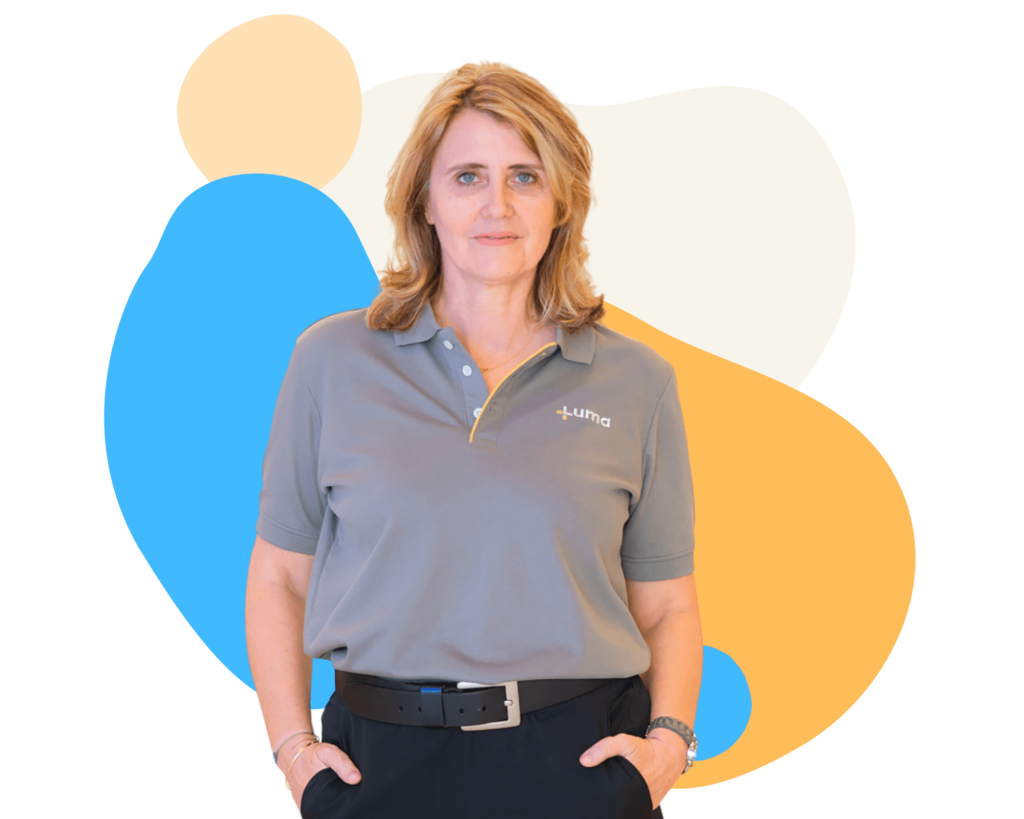
This article was written by Frederique, sharing how she prevents employee burn out while managing a multi-regional company.