



Medically reviewed by Dr Shun Pyae Min, General Practioner, part of LUMA's Medical Team
Thailand has become one of Asia’s leading destinations for medical care. Its private hospitals draw patients from around the world, many hold international accreditation, and specialists are often foreign-trained and English-speaking. Facilities are modern, and same-day specialist appointments are normal. For expats used to waiting weeks for a consultation back home, the standard and speed of care are a genuine upgrade.
Because it is a premium private system, prices can vary widely. The same medicine, test, or scan can cost two to three times more from one facility to the next, and that is where costs quietly get out of hand.
If you are paying out of your own pocket, you will notice these differences right away. If you have insurance, you might not, because the bill goes straight to your insurer. Either way it matters: routine overcharges still eat into your annual limit, leaving less for the large, unpredictable events a plan is really there for, such as a serious illness, an accident, or surgery.
This guide is about getting the same care for a fair price. Whether you already have a plan or you are still comparing your options, the habits below help you avoid overpaying at a Thai hospital and keep more of your cover for when it counts.
The six ways at a glance
- Fill routine prescriptions outside the hospital.
- Question an overnight stay for observation.
- Ask where else your specialist operates.
- Confirm your cover before any planned care.
- Set up your policy to fit how you actually use care.
- Get a second medical opinion before major treatment.
1) The Retail vs. Private Hospital Pharmacy Gap
At LUMA, we compared our own medical insurance claims data with retail pharmacy prices in Bangkok. Private hospitals routinely charge two to six times the retail rate for common medicines, including antibiotics like Augmentin and allergy medicines like Zyrtec. The full breakdown is in the table below, from the LUMA Thailand Private Hospital Medication Markup Index.
For non-urgent refills, filling the same prescription at a retail pharmacy keeps everyday costs down and leaves more of your outpatient limit for when you really need it.
Table 1: LUMA Thailand Private Hospital Medication Markup Index (2024-2026)
| Medication Category | Common Brand / Generic Name | Strength | Retail pharmacy price per tablet (THB) | Typical price at a private hospital in Bangkok (THB per tablet) | Approximate Markup |
|---|---|---|---|---|---|
| Pain & Fever | Paracetamol (Tylenol) | 500 mg | ฿1.40 – ฿1.80 | ฿4 – ฿15 | about 6x |
| Pain & Fever | Paracetamol (Sara / Bakamol) | 500 mg | ฿1.10 – ฿1.40 | ฿2.50 – ฿5 | about 3x |
| Pain & Fever | Ibuprofen (Gofen / local) | 400 mg | ฿4 – ฿9 | ฿18 – ฿25 | about 3x |
| Allergy & Antihistamine | Cetirizine (Zyrtec) | 10 mg | ฿12 – ฿15 | ฿20 – ฿25 | about 2x |
| Allergy & Antihistamine | Cetirizine (Local generic) | 10 mg | ฿2 – ฿4 | ฿7 – ฿10 | about 3x |
| Allergy & Antihistamine | Loratadine (Claritin) | 10 mg | ฿10 – ฿12 | ฿17 – ฿27 | about 2x |
| Allergy & Antihistamine | Chlorpheniramine (CPM) | 4 mg | ฿1 – ฿1.50 | ฿5 – ฿8 | about 5x |
| Antibiotics | Amoxicillin + Clavulanate (Augmentin) | 1 g / 625 mg | ฿25 – ฿45 | ฿80 – ฿110 | about 3x |
| Antibiotics | Azithromycin (Local generic) | 250/500 mg | ฿20 – ฿40 | ฿55 – ฿70 | about 2x |
Source: LUMA Thailand Private Hospital Medication Markup Index (2024–2026)
Methodology: Internal analysis of LUMA historical medical insurance claims in Thailand, cross‑referenced with publicly available retail pharmacy pricing (captured in real time).
Disclaimer: Markup figures are approximate and may vary by private hospital pricing tier.
Key Insights From This Data
- Highest Markup: Standard Paracetamol (Tylenol) and Chlorpheniramine (CPM) carry the highest hospital premiums, costing up to 5x to 6x more per tablet than retail prices.
- Antibiotics Inflation: Common antibiotics like Augmentin see a 3x markup, meaning a routine prescription can easily drain hundreds of extra Baht from an outpatient limit.
- Smart Consumer Choice: Opting for local generic brands over imported names (e.g., generic Cetirizine instead of Zyrtec) at a retail pharmacy yields the deepest overall savings.
When the hospital pharmacy is still the right choice
- Discharge medicines straight after a hospital stay
- Controlled substances that retail pharmacies cannot stock
- Medicines that need continuous refrigeration
- Complex treatment where the doctor and pharmacist coordinate directly
What to say at the appointment
For a standard prescription, you can ask: “Can I have a written prescription to fill outside the hospital?” You can then buy the medicine at a retail chain such as Boots or Fascino, or at a local wholesale pharmacy.
2) Question an overnight stay for observation
After an outpatient visit or an emergency room trip, a doctor may suggest staying overnight for observation. When there’s an underlying condition, an accident, or a symptom like chest pain or a head injury, this is usually the right call.
Unfortunately, admissions aren’t always driven by medical need. Sometimes it is timing: if you arrive in the evening after the outpatient department has closed, overnight admission becomes the default. Sometimes it is well meant, such as admitting someone on an inpatient-only plan so their care is covered. Either way, you can end up admitted when you did not need to be.
Both patterns can leave you worse off. When an insurer later reviews the admission and decides it wasn’t medically necessary, the claim isn’t paid. You end up with a hospital bill for a room where no active treatment took place, for a case that could often have been managed at home in more comfort.
If the outpatient department has closed and you feel stable, you have options. You can ask whether your symptoms can be reviewed in the emergency room and treated as outpatient care, rather than admitted. You can ask what would change if you returned when the outpatient department reopens in the morning.
Any hospital stay also carries a risk from the care itself, including healthcare-associated infections. According to the World Health Organization, roughly 7% of hospitalised patients in high-income countries and 15% in low- and middle-income countries pick up an infection during their stay. A careful doctor weighs that risk against the benefit of being admitted.
Questions to ask before you agree to an admission
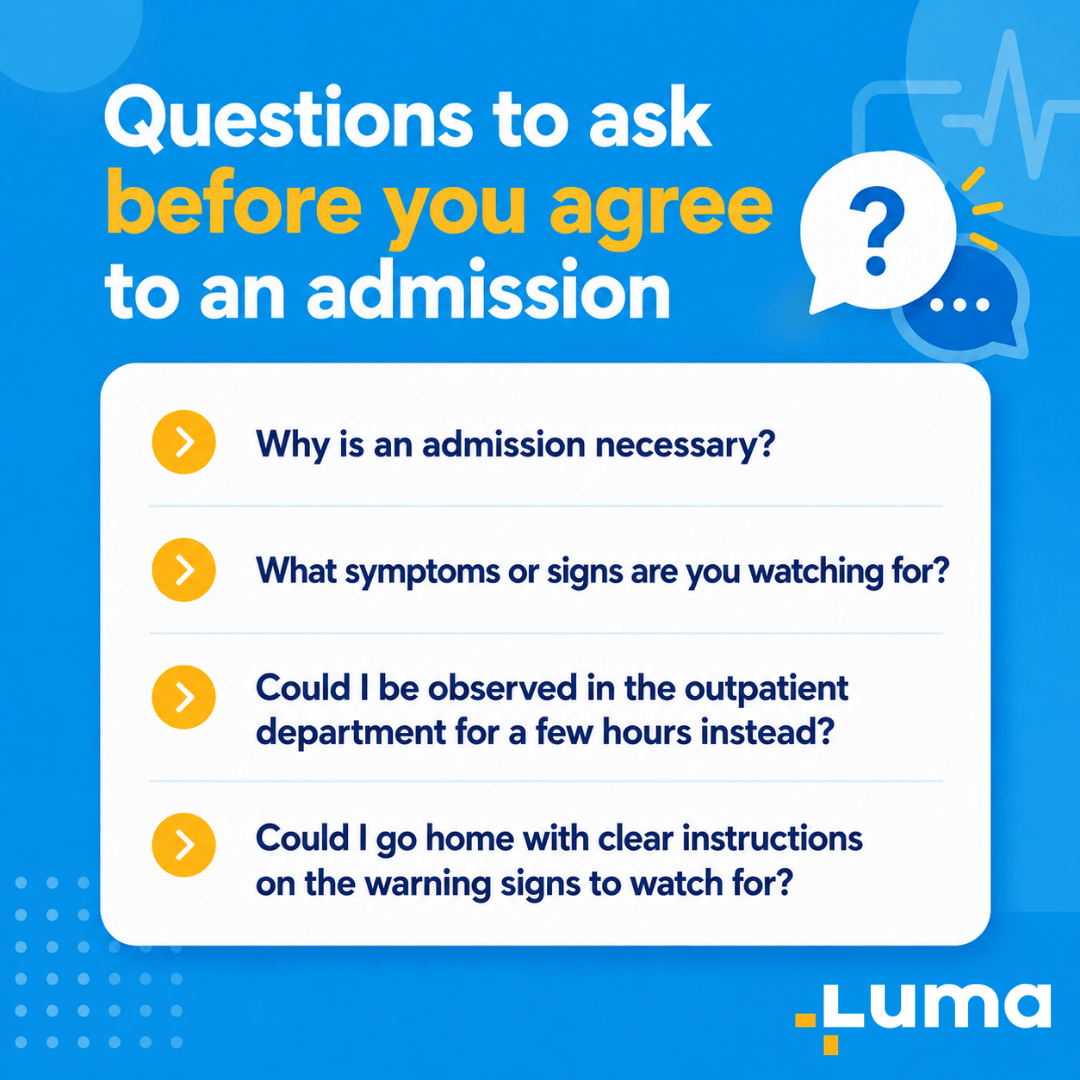
- Why is an admission necessary?
- What symptoms or signs are you watching for?
- Could I be observed in the outpatient department for a few hours instead?
- Could I go home with clear instructions on the warning signs to watch for?
If it is not an emergency and you feel unsure, you can ask for an independent second medical opinion. If you decide to go home, some hospitals will ask you to sign a form recording that you declined the recommended treatment. This is a standard step to protect the hospital, and it is not a reason to worry on its own.
3) Ask where else your doctor operates
For a major procedure, the result depends more on the experience of your medical team than on the name of the hospital. The most expensive facility is not automatically the best choice for your case.
Prices for the same procedure can vary widely between private hospitals in Bangkok, often by two to three times. That difference rarely reflects better medical care. It often pays for comfort and services that do not change the result, such as a larger private room, concierge support, or an international wing.
Many specialists in Thailand work at more than one hospital, and many also operate at large academic hospitals as well as mid-tier private ones. For a planned procedure, ask your specialist which facilities they work in and request an estimate for each. You can often receive care from the same doctor at a hospital where the facility and operating room fees are much lower.
4) For planned care, get your cover confirmed in advance
Planned care means anything you know is coming: a scheduled procedure, a specialist consultation, an elective treatment. Unlike an accident or emergency, you have time to sort out the paperwork before you go in.
The step that matters is pre-authorisation. Before the treatment, share the proposed treatment plan and cost estimate with your insurer. They’ll review what’s covered under your plan, confirm the benefit limits, and issue a letter of guarantee to the hospital. Everyone starts on the same page: you know what your plan will pay, the hospital knows what to bill, and the insurer knows what to expect.
This is what prevents a surprise at the cashier desk. Anything outside the agreed plan and cost, such as an extra test added on the day or an upgrade to a different room category, needs to be checked and approved separately, otherwise it falls on you.
When the hospital is in your insurers’s network, this also unlocks direct billing, so the covered portion of the bill goes straight to the insurer. You avoid paying upfront and waiting for a refund.
5) Set up your policy so it fits how you live
The first four moves save you money at the point of care. This one works earlier, when you choose the plan. Three features give you room to adjust what you pay.
Deductibles. A deductible is a fixed amount you agree to pay on a hospital admission before the plan covers the rest. Accepting an inpatient deductible lowers your premium in exchange for covering that first amount yourself. If you already have group cover through an employer, a deductible works well on a private top-up plan: the group cover handles the first layer, and your private plan covers you beyond it at a lower premium.
Copayments. A copayment is a portion of a cost that you agree to cover, with the plan paying the rest. Plans can apply it in different ways: to a single benefit, to everything, or to the place where you receive care, such as a particular hospital. The purpose is to share the cost and the risk between you and the insurer, and in return your premium is usually lower. On LUMA’s Expat Essential, our health plan built around responsible, sustainble cover, the copayment applies at designated hospitals rather than at every hospital, so the choice of where to receive your care stays with you.
Outpatient cover. Outpatient cover pays for your everyday care: routine doctor visits, prescriptions, and minor treatments. For most people it is the part of the plan they use most, and where the day-to-day value sits. Inpatient cover is the core of the policy. If you genuinely use very little routine care and are comfortable paying cash for the occasional visit, you can leave outpatient cover off to lower your premium. For most members, keeping it is what makes the plan worthwhile week to week.
6) Ask questions, and get a second medical opinion when it matters
Every treatment you agree to becomes part of your care and part of your claim. Whether it’s a prescription, a scan, or a procedure, understanding what’s being proposed and why is what makes the decision genuinely yours.
In private healthcare, decisions can move quickly. A specialist recommends a course of treatment, and it’s easy to say yes without a full picture. Taking a moment to ask a few questions gives you clarity, gives your doctor a chance to explain the reasoning, and helps both of you land on the option that’s actually right for you.
Questions worth asking about a proposed treatment
- Do I really need this? Could the condition improve on its own?
- What is this treatment for, and what are you hoping it will achieve?
- What are the risks and side effects for me, specifically?
- Could this affect my future health in any way?
- Are there simpler or safer alternatives worth trying first?
These questions work for a course of antibiotics, a suggested surgery, or anything in between.
For bigger decisions, a second medical opinion
For major treatment, especially surgery or a serious diagnosis such as cancer, a second medical opinion gives you confidence before you commit. It’s a safety step, not a sign of doubt.
For LUMA members, Medipro coordinates independent case reviews. Each review is carried out by a senior specialist who is at least as experienced as the first doctor you saw, never less. The specialist looks at the diagnosis, the proposed treatment, and any hospital cost estimate, so you can be sure the care in front of you is the right care. If the second medical opinion agrees with the first, you can go ahead knowing two specialists reached the same conclusion. If it differs, you have options to weigh. Those options can include care at more than one hospital, each with its own cost, so you can consider the medical choice and the price together.
Talk to a LUMA advisor
The right structure depends on how you live, how often you use care, and what you want protected. A LUMA advisor can help you set up your cover so it fits, and so it is there in full when you need it most.
In most cases, yes. You can ask your doctor for a written prescription and fill it at a retail pharmacy. Some medicines cannot be dispensed outside the hospital, such as controlled substances or medicines that need immediate hospital administration.
A deductible is a fixed amount you pay on a hospital admission before your cover pays the rest. Choosing one lowers your premium, because you take on the small, predictable costs, while your full annual limit stays available for a large event.
Yes. A second medical opinion is a health safety step, not a financial one. It helps confirm whether a procedure is the right choice, which protects you from unnecessary risk and keeps your limit available for future needs.